 Skip to content
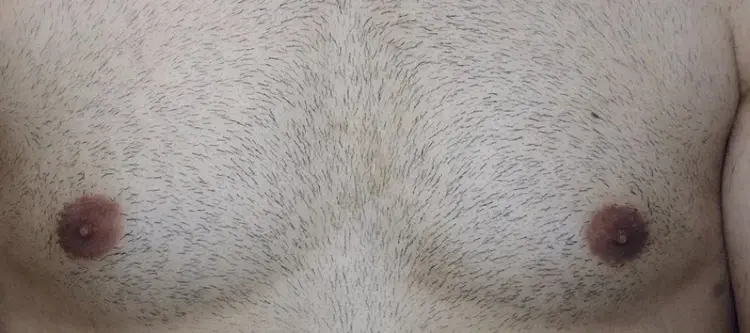
Body hair is an excellent alternative for individuals seeking a hair transplant who lack sufficient donor hair in the back of the head. The process of harvesting hair follicles from the chest or beard area to enable more graft transplants is known as Body Hair Transplant (BHT). In patients with advanced hair loss, such as Norwood scale 6–7, BHT can deliver highly successful results. In this comprehensive guide, you’ll discover what body hair transplantation involves, who makes a good candidate, and the pros and cons of the procedure. We’ll also break down how the process works and what realistic expectations you should have.
With advancements in the FUE technique, expectations for achieving natural-looking, dense hair have never been higher. When donor hair in the back of the head is insufficient, body hair emerges as an excellent supplementary source. This allows for significantly better coverage of bald areas on the scalp.
Data from the ISHRS indicates that body hair is used in approximately 5% of hair restoration surgeries globally. At expert centers such as AHD Clinic, however, that percentage is considerably higher. Thanks to the structural compatibility of beard and chest hair, body hair transplants have become an effective solution for enhancing overall density.
Who Is Body Hair Transplantation Suitable For?
The primary objective of using body hair is to maximize the total graft count placed in the recipient area.
Hair transplantation using body and chest hair is a specialized, effective technique designed for individuals with limited donor availability. However, it is not a standalone cure for hair loss on its own. Instead, it is combined with traditional hair restoration to supplement hair from the back of the head. The ultimate goal is to increase overall density by placing a higher number of grafts into the recipient area.
This approach offers a significant advantage, particularly for patients with depleted donor reserves. Here is who makes a good candidate for body hair transplantation:
1. Patients with Extensive Hair Loss (Norwood Scale 6–7)
For individuals experiencing advanced androgenetic alopecia (Norwood 6–7), the donor area at the back of the head simply doesn’t offer enough follicles to cover the bald region entirely. Fully restoring these areas typically requires between 8,000 and 10,000 grafts. In cases of extensive baldness, chest and beard hair serve as an invaluable backup source for additional grafts.
2. Individuals Undergoing a Second or Third Session
For patients who have had prior hair transplants and now have a depleted or thinning donor site, body hair provides a reliable alternative source. This makes it possible to increase the total graft count for a secondary procedure.
3. People with Naturally Fine Hair
In patients with naturally fine or thin hair, incorporating body hair helps increase graft density per square centimeter, creating a fuller, more voluminous appearance. Combining scalp hair with body hair proves highly effective for covering bald areas.
4. Coverage for Scars, Burns, or FUT Scarring
Body hair can be effectively harvested to cover scars resulting from accidents, burns, or prior surgeries. Additionally, beard or chest hair is an ideal option for concealing linear scars left behind by older techniques like FUT (Follicular Unit Transplantation).
5. Patients with Donor Over-Harvesting or Patchiness
When improper FUE harvesting leaves the donor area on the back of the head patchy or uneven, body hair can be used to camouflage these areas. Since the scalp donor site has already been over-harvested, relying on body hair becomes essential.
6. Softening an Unnatural Hairline
Chest hair, in particular, is preferred to soften harsh or pluggy hairlines from previous unsuccessful transplants. It is especially useful for creating a softer, natural transition along the temples. This approach is typically reserved for cases where scalp donor hair is completely depleted. However, beard hair should never be used on the temples or the frontal hairline.
7. Crown (Vertex) Hair Transplantation
The crown is one of the most common areas for severe hair loss. Grafts are often insufficient for vertex restoration because scalp donor hair is typically prioritized for the frontal area. In these cases, body hair serves as an excellent supplementary source to fill in the crown.
8. Individuals Undergoing Gender Transition
During gender affirmation processes, body hair can provide additional graft support to reshape the hairline into a more feminine or masculine contour.
Which Body Hair Is Used for Hair Transplantation?
Body Hair Transplant (BHT) is a procedure performed by harvesting follicles from external body areas when scalp donor hair is insufficient. This technique offers an effective alternative for patients lacking adequate donor capacity. Prioritizing the right body hair areas plays a crucial role in determining the quality of the final results.
1. Beard Hair: The Most Common Source of Body Hair
Beard hair is the most widely preferred donor source among body hair options. Because beard hair is thick and capable of growing long, it offers a distinct advantage in terms of visual coverage. A single coarse beard hair can provide as much volume as two or three scalp hairs. Since follicles harvested from the beard area share structural similarities with scalp donor hair, they allow for very natural-looking results. The density and quality of beard hair significantly impact overall success, with follicles from the neck and submandibular (under-jaw) regions being utilized most frequently.
2. Chest and Abdominal Hair: An Option for Eligible Candidates
Chest hair serves as the second most common BHT donor site after the beard. Depending on individual hair characteristics, chest hair can be remarkably well-suited for hair restoration. However, candidacy varies from person to person; roughly 5 out of 100 individuals possess chest hair with ideal characteristics for transplantation. If the chest hair is naturally fine or sparse, both overall coverage and success rates will be lower.
3. Arm, Leg, Back, Underarm, and Pubic Hair
While hair from the arms, legs, back, underarms, and pubic area can theoretically be used in hair transplantation, follicles from these regions rarely yield the desired outcomes. This is primarily because their anagen (growth) phase is significantly shorter. Due to their low yield, these sources generally produce weaker results compared to beard or chest hair, which is why we typically advise against extracting from these areas. However, notable exceptions exist; physicians such as Dr. Umar in the United States have demonstrated successful outcomes using arm and leg hair, and his pioneering contributions to this field are highly commendable.
Differences Between Scalp Hair and Body Hair
Scalp hair and body hair carry different genetic codes. Because of this, transplanted body hair retains its original genetic programming even after being moved to the scalp. In other words, chest hair transplanted onto the head will not transform into scalp hair.
| Feature | Scalp Hair | Body Hair |
|---|---|---|
| Growth Potential | Grows indefinitely. | Chest hair grows 5–6 cm; beard hair grows indefinitely. |
| Curl Pattern | Typically straight or wavy (except for Afro-textured hair). | Beard and chest hair are generally curly. |
| Growth Cycle | Has a long anagen (growth) phase. | Chest hair has a short anagen phase; grows for 2–3 months before entering a resting phase. |
At AHD Clinic, we have been utilizing body hair as a secondary donor reserve for hair transplantation since 2010. In our practice, we harvest beard hair for one in every five patients and chest hair for one in every twenty. We have already covered beard-to-scalp hair transplantation in detail in a separate article. Therefore, this guide will focus primarily on chest hair transplantation.
How Is a Chest Hair Transplant Performed?
The procedure is quite similar to traditional FUE hair transplantation, with the main difference being the donor site. Consequently, harvesting grafts from the beard or chest area comes with its own unique characteristics and challenges. Let’s briefly walk through the stages of this operation.
1) Preparation
The extraction area on the chest is shaved to a length of 1–2 mm, marked with a surgical pen, and sterilized using an antiseptic solution. Once sterilization is complete, local anesthesia is administered. However, because the chest region lacks specific anatomical landmarks, administering anesthesia here is more challenging than in the scalp donor area, as a higher volume of anesthetic agent is required.
The most effective approach is to divide the chest into smaller zones and anesthetize each section individually. In other words, only a specific area is numbed at a time, and the grafts within that section are extracted one by one before moving on to the next. This step-by-step method helps minimize the risk of anesthesia-related complications.
Following anesthesia, saline solution is injected to create skin turgor (tension). This firms up the skin, making graft extraction significantly easier and more precise.
2) Graft Extraction (FUE)
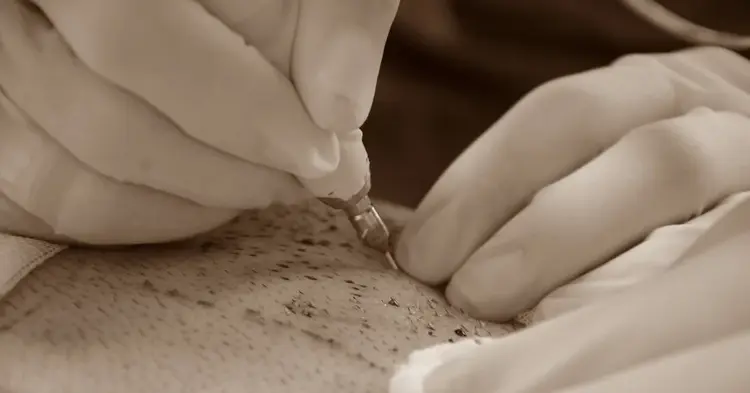
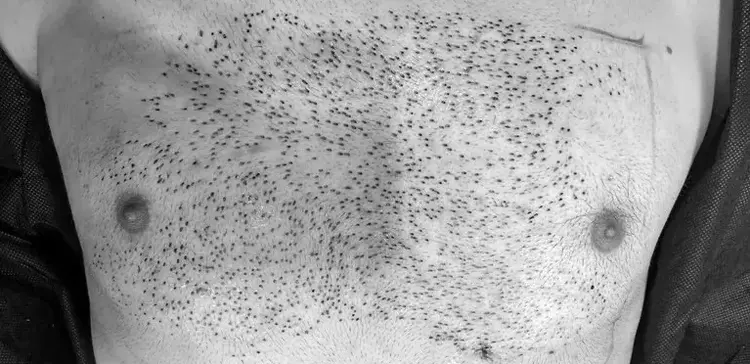
During a chest hair transplant, graft harvesting is performed using the standard FUE technique. Depending on the surgeon’s preference, grafts can be extracted individually using either a motorized micromotor or a manual punch. The punch diameter used for extraction typically ranges between 0.6 and 0.8 mm and should be carefully selected based on graft thickness. Choosing a larger punch diameter can lead to more visible pinpoint scarring; therefore, selecting the correct punch size is crucial during the harvesting process.
Key Considerations During BHT Graft Extraction
- A critical point in harvesting grafts from the chest is that chest hair grows at a much flatter angle relative to scalp hair, lying almost parallel to the skin. This necessitates precise adjustments to the punch entry angle, direction, and insertion depth. Consequently, harvesting BHT grafts requires a significantly higher level of skill and expertise compared to standard scalp FUE.
- Higher Technical Expertise: If the performing physician lacks sufficient experience, graft damage—known as transection—can occur, posing a major obstacle to reaching the target graft count. For this reason, the extraction process must be executed with extreme care and at a deliberate pace. Although this highly technical stage can be more time-consuming, achieving successful outcomes is entirely possible with the right technique and adequate expertise.
Incision (Channel Creation) and Graft Implantation
In a chest hair transplant, creating channels and placing the grafts follows a process similar to traditional hair restoration. First, the recipient area is numbed using local anesthesia. Micro-incisions are then made in the recipient site, creating tiny channels into which the grafts are carefully placed. Depending on the surgeon’s preference, channel creation and graft insertion can also be performed simultaneously using the unshaven DHI (Direct Hair Implantation) technique. DHI is particularly well-suited for body hair transplantation. At AHD Clinic, we prefer using the DHI method due to the significant advantages it offers.
Body Hair Transplantation (BHT) demands a higher level of technical knowledge and surgical skill than standard hair transplants. Choosing an experienced hair transplant surgeon will greatly increase your chances of achieving optimal results.
How Many Grafts Can Be Harvested From the Chest?
It is possible to extract up to 3,000 grafts from an individual with dense, coarse chest and abdominal hair. However, the exact number of grafts that can be harvested depends directly on the hair density and shaft thickness in the donor area. Harvesting this entire quantity in a single day is not recommended; a 3,000-graft procedure should be scheduled over 2 to 3 days. This is because administering anesthesia to the chest area is complex and requires a higher dosage of local anesthetic. The maximum recommended yield for a single session should be approximately 1,500 grafts per day.
If Your Scalp Donor Area Is Insufficient, Body Hair Can Be Your Lifeline
What are the advantages and disadvantages of using chest hair in hair transplantation?
Advantages of Using Chest Hair in Hair Transplantation
- Extra Graft Source: Chest hair provides a valuable secondary donor area. When scalp donor hair is insufficient, chest hair serves as an essential source for additional grafts.
- Ideal for Density Enhancement: Chest hair is particularly effective for increasing hair density. Placing supplementary grafts in sparser areas helps build overall volume.
- Coarse Hair Texture: Chest hair can be thick and coarse, which becomes advantageous when strategically blended with natural scalp hair.
Disadvantages of Using Chest Hair in Hair Transplantation
- Short Anagen Phase (Limited Growth Capacity): Due to its brief growth cycle, chest hair rarely grows beyond 5 cm on the scalp. This can be a limiting factor for patients who prefer longer hair.
- Higher Graft Loss (Increased Transection Risk): If the chest hair is fine or weak, the risk of graft damage during extraction increases. Finer follicles may also struggle to anchor and grow in the recipient site.
- Predominantly Single-Hair Grafts: Chest hair grafts typically contain only a single follicle. Consequently, a higher total graft count is required to achieve satisfactory visual coverage.
- Scarring Risks in Darker Skin Tones: In individuals with darker complexions or Black patients, pinpoint scars in the chest donor area can be more noticeable due to hyperpigmentation.
- Technically Challenging Extraction: Chest hair grows at a flat, acute angle relative to the skin, making extraction far more difficult. Harvesting demands specialized surgical expertise; improper technique dramatically increases transection rates and prolongs procedure time.
- Requirement for Shaving: To harvest chest grafts, the donor site must be periodically shaved prior to the procedure, which extends the overall preparation process.
Post-Operative Recovery and Timeline
- Recovery Process: Patients can return home or to their hotel immediately after the procedure and resume work and social activities within a few days. Recovery following a chest hair transplant is very similar to standard hair restoration; tiny scabs, redness, and minor swelling usually resolve within a few days.
- Ointment and Minoxidil: Applying an antibiotic ointment to the chest donor area is recommended to support smooth healing. Additionally, using topical Minoxidil on the recipient area can help stimulate and support graft growth.
- Shock Loss: The transplanted hair typically undergoes a phase called “shock loss” (temporary shedding), which usually begins after the second week and can continue up to the end of the third month.
- Initial Growth: New hair starts to emerge from the fourth month onward. The initial growth is generally fine, thin, and weak in texture.
- Final Results: Approximately 90% of the transplanted hair is expected to grow by the ninth month, though achieving full density and final results takes between 12 and 15 months.
PRP Therapy: Platelet-Rich Plasma (PRP) therapy can help accelerate graft growth and significantly speed up the post-operative healing process.
Chest and Body Hair Transplant Costs
Body Hair Transplantation (BHT) is generally more expensive than traditional hair restoration. This cost difference stems from the higher level of technical skill, precision, and surgical expertise required for the procedure. Worldwide, only a limited number of specialized surgeons possess the experience needed to harvest and transplant body grafts successfully, which naturally drives up pricing. While BHT costs in Türkiye are higher than standard scalp hair transplants, the country remains a leading global hub—offering world-class clinical quality and expertise at highly competitive rates.
Global Average Costs
Body Hair Transplantation (BHT) prices in the United States generally range between $5,000 and $20,000 USD. Overall costs vary depending on key factors such as the total graft count, geographic location, and the surgeon’s level of expertise.
Frequently Asked Questions (FAQ)
Interested in body hair transplantation? Take action today with AHD Clinic, a pioneer among the elite few clinics capable of delivering successful BHT outcomes. Contact us to schedule your complimentary consultation.
